The two breed standards of the Fila Brasileiro
The FCI/CBKC and CAFIB standards describe the same breed, but come from different organisational backgrounds, with some important differences and distinct emphases. This page presents them side by side in an accessible comparison.
A standard is more than a list of separate body parts: it should describe conformation, movement, temperament and original function as a coherent whole.
Common foundations, different systems
Brazil is the country of origin of the Fila Brasileiro. Within the FCI system, the Brazilian member organisation — currently the CBKC — maintains the breed standard. The FCI publishes it, and dogs are judged against it in its member countries.
CAFIB was founded in 1978 to preserve the breed’s original characteristics, and subsequently developed its own standard and assessment system. This is an independent organisation’s framework, rather than another translation of the FCI standard.
It is therefore more accurate to say that the Fila has two standard systems still referred to today . Their organisational status differs, but both are important to understanding the breed’s history and how it is assessed today.
FCI / CBKC
The publication date of the currently valid FCI standard is 29 September 2016. It governs judging at international dog shows and in FCI member countries.
CAFIB
The Clube de Aprimoramento do Fila Brasileiro was founded in 1978. It has its own standard, breeding records, phenotypic analysis and temperament testing.
These are two different regulatory and assessment systems for the same Fila, rather than two separate breeds.
The differences are best understood in context
The key differences at a glance
Much of the two standards describes similar or identical breed characteristics. On the following points, however, the wording, permitted range or method of assessment differs substantially.
Female: 60–70 cm
Female: 60–65 cm
Six areas with different emphases
Proportions
The FCI specifies a numerical body-length ratio, while CAFIB describes overall harmony and the classic rectangular outline.
Head
The most evident difference is the relationship between muzzle and skull length; much of the head’s basic character is shared.
Size
CAFIB sets a lower maximum height at the withers, while both standards require strength, substance and clearly visible sexual characteristics.
Colour
The assessment of black coats and the acceptance of certain rarer colour varieties differ fundamentally between the two systems.
Temperament
The FCI emphasises controlled handling; CAFIB also emphasises ojeriza and organised temperament testing.
Breed identity
CAFIB has developed a separate system for describing and assessing phenotypic traits considered indicative of crossbreeding.
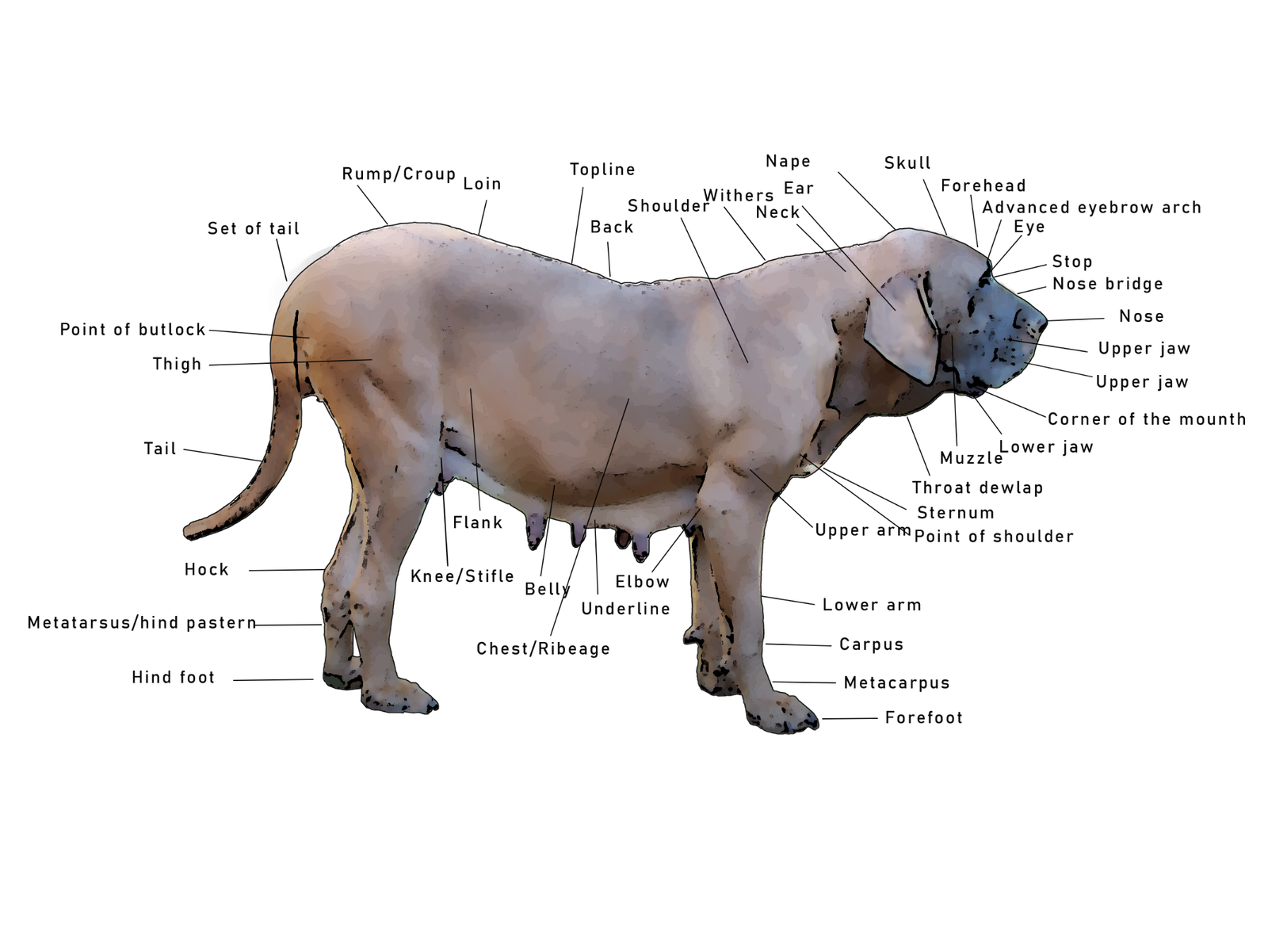
Sita’s anatomy in side profile — click to enlarge
Strength, harmony and agility
Both standards describe a large, strong-boned, rectangular and well-muscled dog. Neither, however, sets a sluggish, excessively heavy molosser as the ideal. Alongside substance, agility and the ability to change direction quickly must remain clearly apparent.
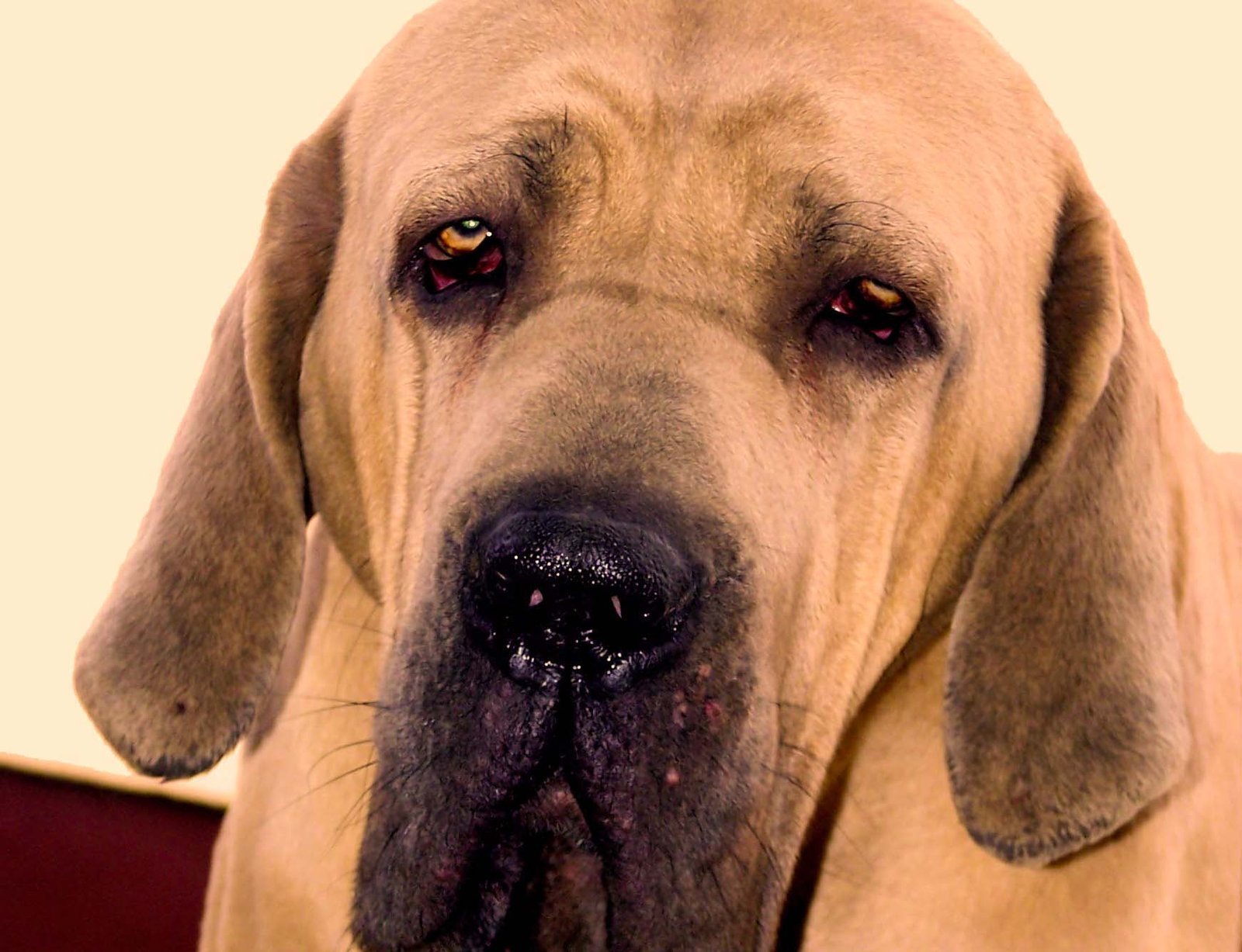 A head portrait showing the characteristic expression, eyes, ears and muzzle.
The difference is more than a matter of centimetres
The Fila’s head is large and heavy, but always in proportion to the body. The skull is broad, the stop low, the muzzle strong and deep, the lips well developed, and the ears large and set towards the rear. The melancholic expression at rest, accentuated by loose skin, is important in both descriptions.
The most readily measurable difference between the standards is muzzle length: the FCI describes a slightly shorter muzzle, whereas CAFIB requires it to be practically the same length as the skull. Under the current FCI standard, a scissor bite is ideal and a level bite is listed as a fault; CAFIB specifies a scissor bite.
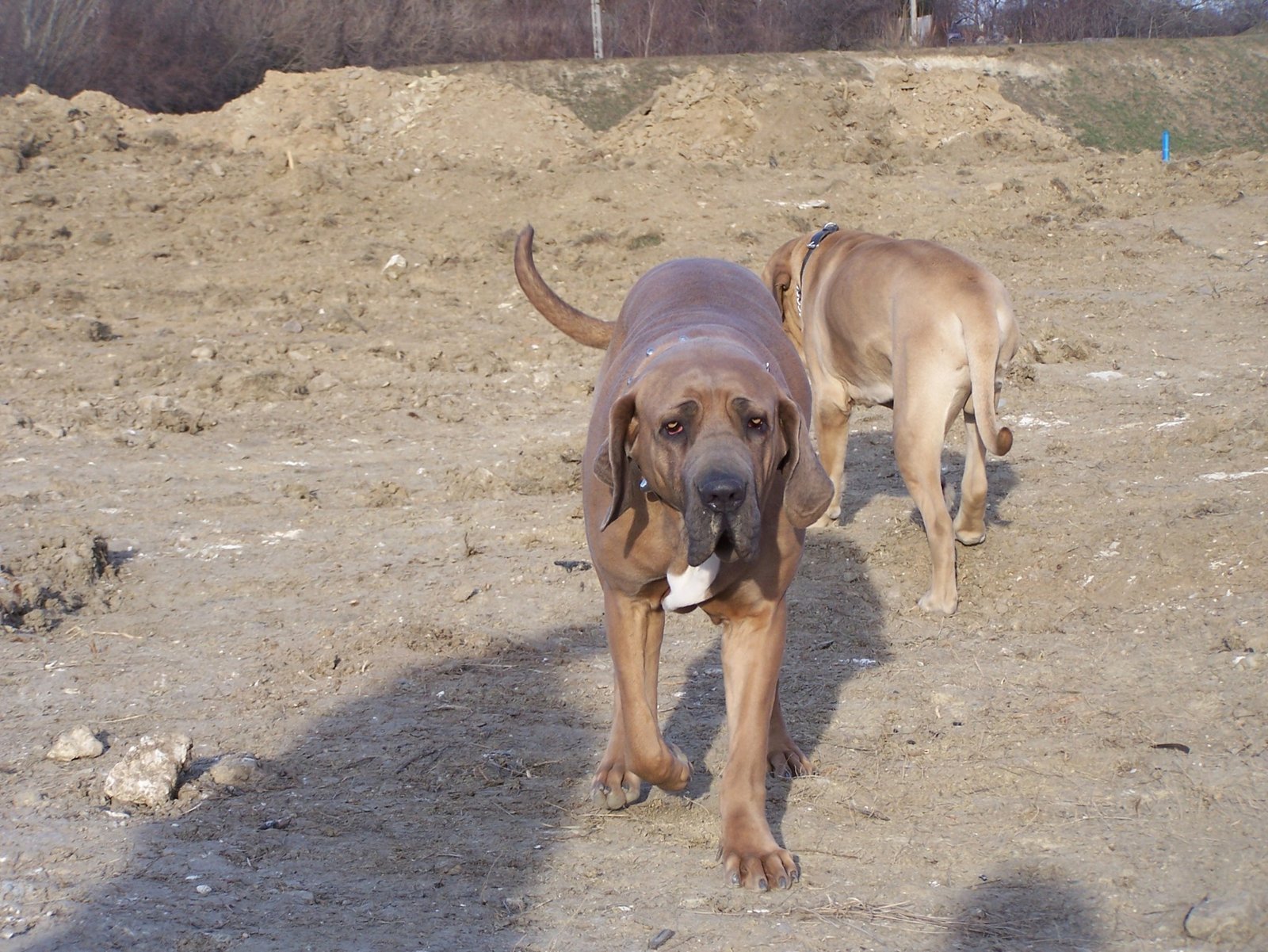
Sita moving, viewed from the front
Much more common ground
Both standards describe a topline rising from the lower withers towards a slightly higher croup, a broad, sloping croup, and the Fila’s characteristic supple, feline movement.
The defining feature of the walk is the two-beat lateral gait, or “camel’s pace”, in which the limbs on the same side move together as a pair. This causes the chest and hips to sway from side to side. The trot should be effortless and ground-covering, and the gallop surprisingly fast for a dog of this size.
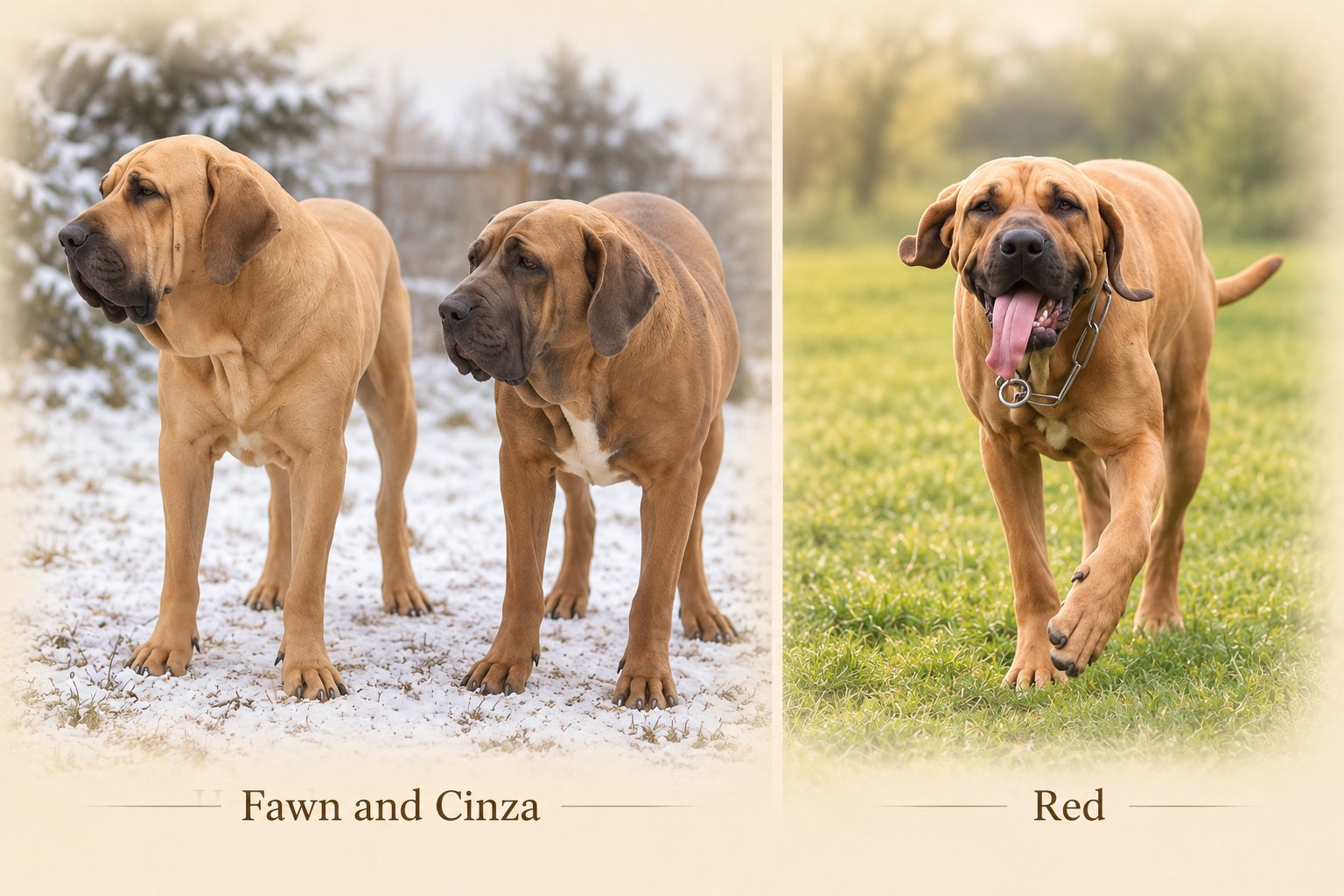
Fawn, Cinza and red colour varieties
Loose skin in common, different colour ranges
Thick, loose and supple skin is a fundamental breed characteristic in both standards. It forms a dewlap at the neck; some dogs also have folds on the chest, abdomen, withers or shoulders. At rest, the forehead should be free from wrinkles.
The FCI permits fawn, brindle and black, with or without a black mask. CAFIB describes various shades of yellow, brindle, light grey/silver and specified white-and-brindle patterns, while excluding jet-black and slate-grey dogs.
One of the most significant differences in approach
Both standards describe a courageous, determined dog, exceptionally loyal to its family and naturally aloof towards strangers.
The current FCI text requires the Fila to be amenable to controlled handling, particularly in the show ring. The CAFIB standard expresses ojeriza more strongly and in greater detail, and requires temperament and gunshot tests for dogs over 12 months old at its own events.
The two standards, topic by topic
The following blocks bring the key information together on one page. The sections can be collapsed, but are open by default so the two systems remain directly comparable. The complete original table appears at the foot of the page.
General appearance, proportions and sexual characteristics
FCI / CBKC
- A molossoid, strong-boned, rectangular, compact and harmonious dog.
- Body length exceeds the height at the withers by 15%.
- The muzzle is slightly shorter than the skull.
- Male and female sexual characteristics must be recognisable at first glance.
CAFIB
- A large, strong, massive dog, without being ponderous or apathetic.
- A rectangular, compact, harmonious and symmetrical build.
- The muzzle is practically the same length as the skull.
- Places particular emphasis on secondary sexual characteristics.
Temperament and nervous system
FCI / CBKC
- Courage, determination, loyalty to the family and natural aloofness.
- Calm, confident behaviour in unfamiliar circumstances.
- The dog must be amenable to controlled handling, especially in the ring.
- Under the FCI classification, no working trial is required.
CAFIB
- Treats the open expression of ojeriza as a breed characteristic.
- Describes a calm, gunshot-steady nervous system in a separate section.
- Uses organised temperament and gunshot tests for dogs over 12 months old.
- Specifies the testing procedure and the direction of the attack.
Head, muzzle, eyes, ears and bite
FCI / CBKC
- A large, heavy and massive head, proportionate to the body.
- Viewed from above, a trapezoid into which a pear shape fits.
- The muzzle is slightly shorter than the skull; strong, broad and deep.
- Almond-shaped eyes set well apart; large, thick, V-shaped ears.
- A scissor bite is ideal; a level bite is listed as a fault.
CAFIB
- A large, heavy, brachycephalic head with a prominent occiput.
- The muzzle is practically the same length as the skull.
- Describes the front, middle and root curves of the muzzle in detail.
- Large, thick ears set towards the rear; deep-set eyes spaced well apart.
- Specifies a scissor bite.
Body, topline, croup and limbs
FCI / CBKC
- A strong, broad and deep body, with the chest longer than the abdominal region.
- The withers are lower than the croup; the topline rises gently.
- The croup is broad, long and slopes at approximately 30 degrees.
- The forelegs are strong and straight; the hindquarters are slightly lighter in bone.
CAFIB
- Requires a similar body shape and depth of chest.
- Describes the topline as two straight sections with a turning point.
- Gives detailed geometric proportions for shoulder, croup, thigh and limb angles.
- Defines croup width and the structural measurement of body length in greater detail.
Movement
FCI / CBKC
- Long, supple, feline strides.
- The principal characteristic is the two-beat lateral gait, or camel’s pace.
- An effortless, ground-covering trot and a fast gallop for the dog’s size.
- Loose construction allows rapid changes of direction.
CAFIB
- Describes the walk, trot and gallop in very similar terms.
- Places particular emphasis on low head carriage at the walk.
- The tail accentuates the lateral sway of the chest and hips.
- Identifies loose joints in the limbs and spine as a breed characteristic.
Skin, coat and colours
FCI / CBKC
- Thick, loose skin over the whole body; a pronounced dewlap at the neck.
- Short, smooth, dense hair lying close to the body.
- Fawn, brindle and black are permitted, with or without a mask.
- White markings are permitted on the feet, chest and tip of the tail.
CAFIB
- Treats skin as one of the breed’s most important characteristics.
- Describes a short, flat, coarser coat whose substantial texture is apparent to the touch.
- Shades of yellow, brindle, light grey/silver and specified white-and-brindle varieties.
- Excludes jet black, slate grey and several other colours associated with crossbreeding.
Size and weight
FCI / CBKC
- Male: 65–75 cm, at least 50 kg.
- Female: 60–70 cm, at least 40 kg.
- Height above the maximum is a serious fault.
CAFIB
- Male: 65–70 cm, approximately 50 kg.
- Female: 60–65 cm, approximately 40 kg.
- The narrower size range keeps the moderately large, functional type in focus.
Faults, disqualifications and breed identity
FCI / CBKC
- The seriousness of faults is assessed in proportion to their degree and their effect on health and welfare.
- Lists general faults, serious faults and disqualifying faults separately.
- Disqualifying faults include excessive shyness or aggressiveness, lack of breed type, certain colours, and the absence of loose skin or camel’s pace.
CAFIB
- The seriousness of a fault increases in proportion to the departure from the ideal.
- Lists general disqualifications as well as temperament-related grounds for disqualification.
- Separate sections describe phenotypic traits considered indicative of Neapolitan Mastiff, Great Dane and English Mastiff influence.
A standard alone is not a breeding programme
A standard defines the desired type and unacceptable departures from it, but cannot replace a combined assessment of pedigree, health, temperament, movement and offspring.
Comparing the standards is valuable when we seek to understand the historical and breeding problems each provision addressed, rather than selecting isolated sentences to declare a “winner”.
Breed Standard and Appearance
The subjects inevitably overlap, but the two pages do not repeat the same material.
Breed Standard
- FCI/CBKC and CAFIB comparison
- sizes, requirements and disqualifying faults
- organisational and historical differences
- a reference based on official sources
Appearance
- recognising correct Fila type
- head, body, skin and movement in images
- accessible explanations of anatomy
- harmony, functionality and exaggeration
The complete original FCI–CAFIB table
The comparison table published on the earlier Braganza website, including every topic and the detailed fault lists, aligned with the version retained on the current Hungarian page. The CAFIB standard was translated by Katalin Boda.
| FILA BRASILEIRO | FCI standard | CAFIB Standard /translated by Katalin Boda/ |
|---|---|---|
| LAST MODIFICATION | Autumn 2016 | Established in 1979 and unchanged since then |
| CLASSIFICATION | Group 2 Pinscher and Schnauzer-Molossoid breeds- Swiss Mountain and Cattle Dogs. Section 2.1. Molossoid breeds, Mastiff type. Without working trial. | /The CAFIB organisation has none of these, since it is specialised in, for and because of one breed, the fila brasileiro. K.B./ |
| GENERAL APPEARANCE | Typically a molossoid breed. Powerful bones, rectangular and compact structure, but harmonious and well-proportioned. Displays, together with a massive body, a great amount of concentrated agility which is easily perceived. The sexual dimorphism must be very well defined and obvious (feminine females, masculine males). | A typical molosser dog. Great size: massive, with strong bones, giving an impression of stout concentration of strength and power, but neither seeming nor being heavy, laggard or apathetic. FIGURE: Massive, rectangular, but harmonious, well balanced, symmetric. Outstanding secondary sexual characters, clearly differentiating males from females. |
| TEMPERAMENT | Courage, determination and outstanding braveness are part of its characteristics. With its owners and family it is docile, obedient and extremely tolerant with children. Its loyalty is proverbial, insistently seeking the company of its master. It displays a calm disposition, distinctive self-assurance and selfconfidence, remaining unperturbed by strange noises or circumstances. An unsurpassed guardian of properties, it also instinctively indulges in big game hunting and cattle herding. While one of its characteristics is a natural aloofness towards strangers especially in its own territory, it must be susceptible to controlled handling, especially in the show ring. | : It is a courageous, determined and daring dog. It does not hide its aversion to strangers, or its traditional tenderness to its owners and family. Consequently it is an unsurpassed watch dog in the cities, and an excellent herding dog and a hunter of big animals in farms. As a result of its temper, at dog shows it does not allow the judge(a stranger) to touch it. And if it attacks the judge, such a reaction must not be considered a fault, but only a confirmation of its temperament. At temper tests, obligatory for dogs over one year old at shows, the Fila attack must be in an ascending diagonal, in front of handler and without showing dependence on him. |
| NERVOUS SYSTEM | Calm, serene and showing assurance, self-confidence, even in strange environments, without being frightened by noises such as gunshots at shows. But the shot must not be discharged at less than five meters, and only to test dogs over one year old. | |
| MOTION | Long and elastic feline-like strides whose principal characteristic is the pace; a two beat lateral gait in which the legs of each side move back and forth exactly as a pair (“camel’s pace”) causing a rolling or rocking motion of the thorax and hips accentuated by the tail when carried erect. When walking, it carries the head lower than the back line. The trot is smooth, free and effortless with a long, powerful and reaching stride. The gallop is powerful, attaining unsuspected speed for such a large and heavy dog. Due to its articulations, typical of molossoids, the movements of the Fila not only give the impression but actually allow him to make sudden and rapid changes of direction. | MOTION WALK: Wide, elastic and rhythmical paces, but at the same time seemingly heavy, just like the felids. While walking, its head must be at the level of or below the back line. At walk, the main characteristic is that the Fila first moves two legs of one side of the body and then the opposite legs, a perfect camel step. As a result, there is an alternate side swing of the thorax and hips, which is emphasized by the tail when it is upwards. TROT: Easy, soft, light, wide and efficient. GALLOP: Powerful, reaching an unsuspected speed for a dog of such a size and weight. Fila movements, while walking, make evident its loose joints in the legs and vertebral column, a characteristic of the breed. As a result, the Fila is able to change route suddenly and quickly, even at a gallop. |
| EXPRESSION | At rest, he is calm and confident. Never bored or distracted. When excited, his expression and gaze reflect determination and alertness. | |
| HEAD | The head of the Fila is big, heavy and massive, always proportionate to the whole body. From a top view it resembles a trapezoid figure into which a pear shape is inserted. The muzzle is slightly shorter than the skull. | Brachycephalic, great, heavy. Seen in profile, the length of the muzzle is practically equal to that of the skull; good depth; outstanding occipital; big and fallen ears; low forehead depression(stop). Front view, it is wide. with a strong and convex muzzle the skull is wide, lightly curved, also at its sides. |
| SKULL | The profile of the skull shows a smooth curve from the stop to the occiput, which is well-defined and protuberant especially in puppies. From a front view it is large, broad with the upper line slightly curved. Lateral lines come down almost vertically, in a slight continuous curve narrowing towards the muzzle. From a front view it is practically nonexistent. Seen from the side, the stop is only slightly pronounced and virtually only formed by the well-developed eyebrows. | Seen in profile, it shows a light curve from the root of muzzle towards the outstanding occipital. Full face, it is wide, large, lightly curved. Its Sides go down in a very smooth, almost vertical, curve, without showing swollen parotids and never forming a step at the muzzle. At this point there is just a light curve. |
| OCCIPITAL | Outstanding, well apart from the nape. | |
| STOP | From a front view it is practically nonexistent. The median groove is slight and runs up smoothly to approximately the centre of the skull. Seen from the side, the stop is only slightly pronounced and virtually only formed by the well-developed eyebrows. | (Forehead depression of frontal cavity) Full face, it virtually doesn´t exist in its place, there is a groove (depression) between the eyes, in a smooth ascent up to the middle of the skull. Seen in Profile, it is low, inclined, but perfectly visible, formed by the superciliary arches. |
| MUZZLE | Strong, broad and deep, always in harmony with the skull. The muzzle is slightly shorter than the skull. Seen from above, it is full under the eyes, slightly narrowing towards the middle of the muzzle and again broadening slightly to the front line. Seen from the side, the muzzle is straight or has a Roman line, but never turned up. The front line of the muzzle is almost perpendicular to the bridge of the nose with a slight depression right under the nose, forming a perfect curve with the upper lips. The upper lip is thick and hangs over the lower lip, defining the lower line of the muzzle, which is almost parallel to its upper line. The labial commissure is always visible. The lower lips fit closely to the jaw as far as the canine teeth, then become loose, with indented edges. The muzzle is very deep at its root, but its depth does not exceed its length. The labial commissures form an inverted U. | Seen in profile, its length practically equal to the skull length. Rectangular, but very deep. Nevertheless, its depth should never be equal to or exceed its length. The front line must be straight, going down lightly inclined backwards. At half the way, it forms a wide and perfect curve down towards the lower line of muzzle, which is also defined by the upper lips. These lips are thick and hang over the lower ones, which are firmly fixed to the mandible(lower jaw), but loose at the sides, showing indented edges. Visible lip(labial)commissure. Full face convex muzzle curves(at front, medium and root), forming a full muzzle, which assures good teeth roots implantation. As a result, under the eyes, the muzzle is round in sequence it narrows very lightly up to the middle curve and then it enlarges again up to the front curve, originating a widely curved mouth gap. Nevertheless, seen from above the muzzle must not belt at the region of the middle curve, which is only perceptible. |
| NOSE | Well-developed, broad nostrils not occupying entirely the width of the upper jaw. Colour: black. | Wide nostrils, well developed, but never occupying the whole width of the jaw. always black. |
| EYES | From medium to large size, almond shaped, spaced well apart, medium to deep set. Permissible colours – from dark brown to yellow, always in accordance to the colour of the coat. However a darker colour is preferred. Due to the loose skin, many individuals present drooping lower eyelids which are not considered a fault as such; a detail accentuates the melancholic expression which is typical of the breed. | A sad look when at rest, but energetic and determined when on the alert. Of medium to big size, lightly egg shaped, profound, wide apart. Their color varies from dark chestnut to yellow. In harmony with the general color and pigmentation of the fur. Due to the loose skin, some dogs present fallen low eyelids. This is not considered a fault, because it just only increases its typical sad expression. |
| EARS | Pendant, large, thick, V-shaped. Broad at the base and tapering to the ends. Rounded tips. Attached at the back of the skull, in line with the eyes when in repose. When roused, the ears are above the original position. The root is oblique, with the front edge higher than the back edge. Falling over the cheeks or folded back showing the inside (rose ear). | Fallen, big, thick, very thick at the root, narrowing towards its end, forming a rounded edge. Its root is inclined: the fore edge is higher than the back one. Its insertion is at the rearmost part of the skull and variable: low when the dog is at rest and high when it is on the alert. Laterally fallen ears and rose ears are allowed. |
| TEETH AND BITE | The teeth are significantly wider than long. Strong and white. Upper incisors are broad at their root and taper to the edge. Canines are powerful, well set and well apart. The ideal bite is the scissor bite, but a level bite is also permitted. | Teeth relatively small, but strong and sound. Upper fore teeth(incisors)are wide at the root and thin at the end. Powerful canine teeth, wide apart. Scissors shaped bite: this means that the lower incisors close just scraping the inner surface of the upper incisors. |
| NECK | Extraordinarily strong and muscled giving the impression of a short neck. Slightly curved at the upper side and well detached from the skull. Dewlaps at the throat. | Generally kept low, it is extraordinarily developed and has strong muscles, but apparently it is short. Its upper edge (nape) is slightly convex, Forming the so called stallion curve. Under the throat it has a parallel double skin, hanging loose, in a longitudinal position(dewlap). |
| UPPER LINE | Withers, in sloping line, are set well apart from each other due to the distance between the shoulder blades. Withers are set lower than the croup. After the withers, the upper line changes direction, ascending smoothly to the croup. Back line shows no tendency to sway or roach back. | Open and low withers (plates), on account of the fact that the plates(omoplates) are wide apart. Nevertheless, the withers must be perfectly visible, forming a descending line. At the lowest point of this descent line(hinge), it changes direction, going upward smoothly, in a straight line, till the fore tip of the rump(ilium). So the upper line is formed by two straight lines one till the end of the withers the other one till the rump. |
| HIND QUARTERS-RUMP | Broad, long, sloping at angle of approximately 30 degrees to the horizontal and ending in a smooth curve. The croup is set a little higher than the withers. From a back view, the croup is ample almost as wide as the chest and can be even broader for females. | Structured by the wide and long iliac, forming an angle of 30 degrees from the horizon. There is a smooth curve from the fore tip of the rump(ilium) till the rear(ischium), or the rump end. The ilium tip is at the same level or a little higher than the plates. A horizontal imaginary line starting from the rump end(ischium) must reach the shoulder tip and ahead of the chest tip. This distance defines the length of the dog. Viewed from behind, the hips must be as large as the thorax, mainly in males. In the females the hips can be larger. |
| TRUNK | Strong, broad and deep, covered with thick, loose skin. The chest is longer than the rear part of the body. The length of the body, measured from the point of the sternum to the point of buttock, exceeds the height at the withers by 15%. | Strong, wide and deep. The thorax is longer than the abdomen. |
| THORAX | Well-sprung ribs though not interfering with the position of shoulder. Deep and broad chest reaching to the level of the elbows. Well-pronounced brisket. | Perfectly arched ribs, forming a wide and deep chest, but never being an obstacle to the free motion of the shoulders. In a well framed shoulder, the ribs must go down till the tip of the elbow. |
| FLANK | Shorter and not so deep as the thorax, showing distinctly the separation of the two component parts. In females the lower part of the flank is more developed. Seen from above, the loin is narrower than the thorax and croup but should not form a waistline. | Shorter and less deep than the thorax, it must be well sculptured, in order to make it possible to differentiate all its parts. Seen from above, it must be less wide and full than the thorax and rump, but without belting. |
| LOWER LINE | A long chest and parallel to the ground in all its extension. Slightly tucked up but never whippety. | From the tip of the chest(manubrium of sternum) it goes down, in a wide and perfect curve, forming the forechest after that, a straight line, parallel to the ground, follows till the rear end of the sternum(xiphoid) and from this point it goes up lightly in the males till the penial sheath, and in the females till the flank lap, which is more developed in them, hiding the ascending line of the abdomen and influencing the lower line. |
| FORE QUARTERS-SHOULDERS | The shoulder structure should be composed by two bones of equal length (scapula and humerus); the former at 45 degrees to the horizontal and the latter 90 degrees to the scapula. The scapula-humeral articulation forms the point of shoulder which is situated at the same level but slightly behind the point of sternum. In the ideal position, the point of shoulder should be half way from elbow to withers. An imaginary perpendicular line coming down from the withers should cut the elbow and reach the foot. | They are made up of two bones of equal size; omoplate or scapula and humerus. The former at 45 degrees from the horizon and the last one at 90 degrees from the plate. The joint of the omoplate with the humerus forms the point of the shoulder, which must be at the same level of the chest tip, but a little behind it. In the ideal structure the shoulder should fill the space from the withers to the sternum and the shoulder tip should be just at the middle of this distance. |
| FORELEGS | Forearm: The limbs must be parallel. Strong and straight bones. Carpal joint (wrist): Strong and apparent. Metacarpus (pastern): Short, slightly sloping. The length of the limbs, measured from the ground to the elbow, is 50% of the distance from the ground to the withers. | Strong and straight bones. Apparent wrists (carpus), short and slightly inclined metacarpus.A perpendicular imaginary line going down from the withers(plates) must reach the elbow and the foot. In the ideal structure, the elbow(olecranium) should be at the sternum level. |
| FOREFEET | Forefeet: Strong and well-arched toes not too close to each other. The dog stands on thick toes and pads which are long, broad and deep. In the correct position, the feet should point forward. Strong, dark nails; white nails permissible when the corresponding toes are white. | They are formed by strong and well arched fingers, not too near, supported by thick pads put around a wide, deep and thick foot pad. Fingers are in a correct position when they point ahead. The nails are strong and dark-but can be white when this is color of the respective finger. |
| HIND QUARTERS-RUMP | Less heavy boned than forelegs but never appearing thin compared to the overall build. | Structured by the wide and long iliac, forming an angle of 30 degrees from the horizon. There is a smooth curve from the fore tip of the rump(ilium) till the rear(ischium), or the rump end. The ilium tip is at the same level or a little higher than the plates. A horizontal imaginary line starting from the rump end(ischium) must reach the shoulder tip and ahead of the chest tip. This distance defines the length of the dog. Viewed from behind, the hips must be as large as the thorax, mainly in males. In the females the hips can be larger. |
| THIGH | Broad with curved outline shaped by strong muscles coming from the ilium and ischium which design the curve of the buttocks and for this reason the ischium must have a good length. | Structured by the femur(thigh bone), which forms an angle of approximately 60 degrees from the horizon or from the ground and an angle of 90 degrees from the iliac. It is large, with convex edges, formed by the muscles which go down the ilium and the ischium – the last ones drawing the rump curve. This is the reason why the ischium should always have a good length. |
| HIND LEG | Hindlegs are parallel. Tarsus (hock): Strong. Metatarsus (Rear pastern): Slightly sloping, longer than the metacarpus. Moderately angled stifle and hock. | : It is mainly formed by the tibia(shin bone). When the angulation is good, the knee outstands and projects the hock backwards. Strong and outstanding ankle(tarsus). The metatarsus(instep) is inclined and higher than the metacarpus. Viewed from the rear, the hind legs must be parallel and the inner part of the thigh should be very muscular. |
| HINDFEET | A little more oval than the forefeet but otherwise identical. Should not present dewclaws. | They are little bit more egg shaped than the fore feet and equal to these in the rest. They must not have dewclaws(ergots). |
| TAIL | Very wide at the root, medium set, tapering rapidly to reach the hocks. When the dog is alert, the tail is raised high and the curve at the extremity is more accentuated. Should not be carried curled over the back nor touch it. | Viewed in profile, it should not interfere with the rump curve on the contrary, it must be well adapted to it, not outstanding too much. Its insertion is medium. When the dog is excited, it goes up, but it must never take an upright position or even fall over the back. At the end it forms an open curve(hook curve), but it should never twist up. When the dog is at rest, it falls straight, till the hock. Seen from rear, its root must be very wide and strong, narrowing little by little down to its end. |
| SKIN | One of the most important breed characteristics is the thick, loose skin over the whole body, chiefly at the neck forming pronounced dewlaps and many times it can extend to the brisket and abdomen. Some individuals present a fold at the sides of the head, also at the withers running down to the shoulders. When alert, the dog raises its ears and the contraction of the skin on the skull forms small longitudinal wrinkles between the ears. | It is one of the most important characteristics of the breed, it must be thick, loose all over the trunk, mainly in the neck, and forming a dewlap at the throat. In many cases this dewlap goes down the chest and abdomen. Some dogs have a ply(wrinkle) at head, sides, and also at the withers and shoulders. When the dog is at rest, the head must not present plies. When it is on the alert, the contraction of the skull skin in order to raise the ears forms small longitudinal plies. The forehead must not have plies. |
| FUR | Short, smooth, dense and close to the body. | Dense, short and smooth coat. The hair is rough and thick, a characteristic which can be easily detected by sight and touch. A little thicker at the withers. |
| COLOR | All solid colours are permitted except the disqualifying colours: white, mouse-grey, dappled and merle. Brindle Filas may have lighter or very dark stripes. A black mask may or may not be present. In all permitted colours, white markings are allowed on the feet, chest and tip of the tail. They are undesirable elsewhere. White markings covering more than one quarter of the body must be penalised. | The following colors are allowed 1. Yellow in all its shades, from the reddish brown(light bay) to red. 2. Yellow in all its shades, from the reddish brown to red, but with a gray shadow. 3. The first and second colors, but with black mask and ears, or only black mask. 4. Striped like a tiger, or “araca” (yellow hair with split black stripes). Basic color equal to one of the previous ones with black stripes or streaks. The streaks are thin, with the same width from the beginning to the end and irregularly distributed all over the body. They also have different lengths and link at the upper line of the body, along the vertebral column, drawing a “V”. 5. Striped with black mask and ears. 6. White with big brindled spots, like those described in item number 4. The white color must be pure, without dark spots on the skin(making shadows). 7. Light gray, silver 8. Any of these colors with white spots, usually on the members, chest and tail and not so frequently on the neck and muzzle, going up to the head. |
| HEIGHT | Males: from 65 cm to 75 cm at the shoulder. Females: from 60 cm to 70 cm at the shoulder. | (at the withers) Minimum: males 65cm, females 60cm. Maximum: males 70cm, females 65cm. |
| WEIGHT | Males: minimum: 50 kg. Females: minimum: 40 kg | Males around 50kg, females 40kg. |
| FAULTS | Monorchidism or cryptorchidism, attempts to use artificial methods, albinism, lack of type, etc. | Everything that is far from the ideal described in this standard. The fault turns to be graver in the direct ratio of this distance. |
| GENERAL DISQUALIFICATIONS | 1. Aggressiveness towards its own owner. 2. Cowardice. 3. Flesh-coloured nose. 4. Overshot bite. 5. Undershot bite with teeth visible when the mouth is closed. 6. Lack of 1 canine or 1 molar except the 3rd one. 7. Wall eyes. 8. Cropped ears or docked tail. 9. Croup lower than the withers. 10. White, mouse-grey, dappled or merle colour. 11. Males under 65 cm and females under 60 cm of height at the shoulder. 12. Skin not loose and supple 13. Dog not walking at camel’s pace. | 1. Cut ears 2. Cut tails 3. Flesh color nose 4. Prognathism influencing the fore line of the muzzle 5. Any dental lack 6. White without any spot of another color 7. White(basic color)with black spots 8. Jet Black 9. Slate grey 10. Jet black or slate grey with white spots 11. Mouse(rat)gray 12. Bluish gray 13. Gray(basic color) with black spots 14. Mouth gap in acute angle 15. Temper without a positive reaction to attack 16. Strong negative sensibility to shot |
| FAULTS BY SEVERITY | Very serious faults: 1. Small head. 2. Dry upper lips 3. Pronounced stop seen from the front. 4. Protruding eyes. 5. Lack of 2 teeth except PM1 (first premolars). 6. Lack of dewlaps. 7. Apathy and timidity. 8. Shooting shyness (negative behaviour when shooting). 9. Roach back. 10. Level back, not rising towards the hindquarters. 11. Excessively tucked-up abdomen. 12. Cow hocks. 13. Lack of angulation at the hindquarters (straight hocks). 14. Light bones. 15. Lack of substance. 16. Height exceeding the maximum (males over 75 cm, females over 70 cm). 17. White markings exceeding 1/4th (one fourth) of the body 18. Lack of pigmentation on eyelids. 19. Round eyes. 20. Square-built. Serious faults: 1. Short muzzle. 2. Small ears 3. Highly set ears 4. Excessively light coloured eyes. 5. Wrinkles when the dog is in repose. 6. Undershot bite. 7. Two missing teeth. 8. Horizontal folds under the throat, rather than a dewlap. 9. Sway back. 10. Very narrow croup. 11. Curled tail carried over the back 12. Chest insufficiently deep. 13. Any departure from the descriptions of the forequarters and hindquarters. 14. Over angulated hindquarters (sickle hocks). 15. Short steps (poor reach). Minor faults: Any departure from the foregoing descriptions. Note• Male animals should have two apparently normal testicles fully descended into the scrotum. Only functionally and clinically healthy dogs, with breed typical conformation should be used for breeding. | |
| MIXBREEDING DISQUALIFICATIONS | MIXBREEDING DISQUALIFICATIONS 1st: Here are listed the most common faults. To make it easier to understand them, they are divided by items like the general aspect, head, etc. On account of the great variety of genetic heritages and consequently of phenotypes, the judge will not find a group of these characters in just one dog. So the judge must disqualify a dog whenever he finds one or more of these faults, and when he gets convinced of mixbreeding by the intensity and representativity of them 2nd: There are dogs with somatic(physical) details which denounce several mixbreedings. This fact must not be a surprise to the judge, because it only proves the extension and the variety of miscigenation(mixbreeding)with several(and not only just one)breed. A) NEAPOLITAN MASTIFF MIXBREEDINGS: 1- A strongly brevilineous type, with short legs, wide chest. Concave upper line, resulting in high and plane rump and high insertion of tail, which is short, tending to twist up and fall over the back. Lower line in opposite curves, concave in the thorax (thorax like a sleeping net) and convex in the abdomen(tucking up). 2- Wide skull, its curves go down the arched sides of the head just like in a ball. In contrast, the muzzle seems narrower. High insertion ears, Round “stop”, formed by the frontal bone, which is high at the forehead, Mouth gap in acute angle. Viewed in profile, the muzzle depth is equal to or bigger than its length. Full face it is narrow. So the nose occupies all its front. Without convex curves. Transversal loose skin at throat. A boring expression with half closed eyes and open mouth, showing the tip of the tongue. 3- Slate grey colour, gray as a basic color, with black stripes lead gray. B) GREAT DANE MIXBREEDINGS: 1- Square figure, longilineous, long legged, long necked and with scarce dewlap at the throat. As a result of short sternum, the lower line tucks up in a diagonal(herring thorax). Very big flank lap, even in males. Firm joints and hard motion. Rump without inclination. Thin tail. Opened shoulders, going onward and placed just under the neck. 2- Narrow head. Big and large nose. Not very deep head. Plain and flat skull small “stop” narrow and thin ears, highly inserted. Eyes tending to blue. Long muzzle, with lower line parallel to the upper one. 3- Jet black color, mouse gray or bluish gray, gray, as basic color, with black spots, white with black or gray spots, or with spots of these two colors. Low fur, with very thin hair, too close to the body. C) ENGLISH MASTIFF MIXBREEDINGS: 1- Huge shape, tending to square. Straight back. Withers higher than the rump. 2- Full face, the head is wide, seeming narrow between the ears, which are small, in a “V” shape, thin, highly inserted(practically at the top of the skull line), and almost always black. Globular forehead, abrupt “stop”, formed by the frontal bone. Wrinkled skin at forehead. Little outstanding occipital. Viewed in profile, the muzzle length is half the skull length(1 to 2). Deep at the root, but less deep at the tip, where the upper lip is not so deep. The fore line forms a right angle with the upper line and is vertical. It may be inclined forwards, as a result of pincers shaped bite or inferior prognathism. Prominent chin, resulting in an inclined fore line. Black mask. 3- Yellow apricot as a basic color, with too many large and egg shaped stripes put together, forming black stains. They are so numerous that the visible parts of the basic color are practically of the same width of the stains, giving a false idea of striped or a dark tigerlike color. |